Derby Roofers
Tel: 01332-529704
Chimney Service Swanwick near Alfreton Derby
If you have a chimney stack on your Swanwick home that needs repairing, repointing, or making watertight, this page is for you. We carry out roofing-led chimney services for homes across Swanwick near Alfreton and the wider DE55 area. This includes lead flashing repair, chimney repointing, flaunching, pot replacement, stack rebuilds, liner installation, and full chimney removal where needed.
We are Derby Roofers — a roofing contractor based in Loscoe, Heanor, just a short drive from Swanwick via the A38. We serve residential and commercial properties across Derbyshire. Chimney work is one of the most common roofing jobs we carry out, and it is one of the most overlooked areas of home maintenance.
Swanwick sits between Alfreton and Ripley in Amber Valley. The village has a wide mix of housing — from Victorian terraced cottages on streets like High Street and South Street, which date back to the coal mining and Butterley ironworks era of the 19th century, through to newer detached homes on estates like Swanwick Fields and Lily Street Farm. Both old and new chimneys develop problems. The causes are different, but the outcome is the same: water gets in, damage builds up, and a straightforward repair becomes a bigger job.
Chimney Service Swanwick near Alfreton Derby is available now. Call us on 01332-529704 for a free quote or to book a survey.
What a Chimney Inspection From a Roofer Covers
Before any repair work starts, we carry out a proper inspection of the chimney stack and its connection to the roof. This is the correct starting point. It tells us exactly what needs doing and stops us — or you — guessing.
During an inspection we check:
- The chimney stack brickwork — looking for cracked, spalled, or missing bricks, loose sections, and any signs of movement or leaning
- Mortar joints — checking whether the pointing between bricks has eroded or failed, and how deep the deterioration runs
- Flaunching — the mortar bedding at the top of the stack that holds the chimney pots in place; cracked or sunken flaunching allows water to pool and penetrate the crown of the stack
- Chimney pots and cowls — checking for cracked pots, loose or missing caps, and whether cowls are doing their job of keeping water and birds out
- Lead flashing — the lead seal at the point where the chimney meets the roof slope; this is the most common source of chimney-related water ingress in Derbyshire properties
- Back gutter — the hidden flashing at the back of the chimney stack on the roof slope, which is frequently the first place a chimney leak appears but the last place homeowners look
Many Swanwick homeowners only discover a chimney problem after damp has already appeared inside — a patch on the ceiling near the chimney breast, plaster staining below a stack, or bubbling paint on an upstairs wall. By that point the water has usually been getting in for some time. An early inspection protects both the chimney and the structure around it.
For homes in Leabrooks and Somercotes, the same inspection process applies. Older properties across this part of Amber Valley share similar chimney construction and the same weather exposure.
Signs Your Swanwick Chimney Needs a Roofer
Some chimney problems are visible from the ground. Others only show up from roof level. These are the signs worth acting on:
Visible from outside:
- Mortar crumbling or falling from between chimney bricks
- White staining (efflorescence) on the brickwork — a sign of water soaking through and leaving mineral deposits behind
- Cracks in the flaunching at the crown of the stack
- A chimney pot that is visibly leaning, cracked, or has shifted out of position
- Dark staining around the base of the stack where it meets the roof tiles
- Lead flashing that has lifted, pulled away, or shows visible cracking
Visible from inside:
- Damp patches on the ceiling or wall near the chimney breast
- A musty or damp smell coming from a fireplace that is no longer in use
- Paint or plaster peeling near the chimney — especially on upper-floor rooms
- Water marks in the loft near where the chimney passes through the roof
Properties in South Wingfield and Ironville see the same warning signs. Homes on elevated ground near the A38 corridor take a hard battering from prevailing south-westerly winds, and chimney stacks — sitting at the highest point of the roof — take the full force of it.
If you have spotted any of these signs at your Swanwick property, call us on 01332-529704. Catching chimney problems early is nearly always cheaper than leaving them.
Chimney Repointing, Flaunching, and Stack Repairs for Swanwick Homes
This section covers the structural repair work we carry out at chimney level. These are roofing jobs — they require safe access, the right materials, and an understanding of the brickwork you are working on.
Chimney Repointing
Repointing is the most common chimney repair we carry out across Swanwick and the surrounding Alfreton area. Over time, the mortar between chimney bricks breaks down due to freeze-thaw cycles, rain, and the sulphur produced by fuel burning in the flue. Once mortar fails, water gets into the joints, freezes, expands, and forces the brickwork apart. Left untreated, this leads to spalled bricks, loose sections, and eventually structural instability.
The correct method is to grind or rake out the failed mortar to a depth of at least 15–20mm on all four faces of the stack — not to apply new mortar over the top of old. Pointing over existing failed mortar is a short-term patch that fails again quickly. We remove the old material properly before refilling with a mortar mix suited to the age and type of brickwork.
This matters particularly for older Swanwick properties. Victorian cottages on South Street and High Street were built using soft brick and a lime-based mortar. Using a modern cement-heavy mix on this type of brickwork creates a harder joint than the surrounding brick — when the stack flexes or absorbs moisture, the brick face cracks and spalls rather than the mortar joint giving way. We use the right mix for the build.
Flaunching Repair and Replacement
Flaunching is the mortar bed at the top of the chimney stack that holds the pots in place and sheds rainwater away from the crown. When flaunching cracks or sinks, pots become loose, and water sits in the gaps. In frost, that water freezes, expands, and accelerates the damage to the top of the stack.
We remove failed flaunching entirely before re-bedding. Patching over existing flaunching gives a finish that will fail again within a short time. Properly replaced flaunching should seal the crown, hold the pots firmly, and direct water off the top of the stack.
Chimney Pot Replacement and Capping
Cracked or broken chimney pots let water into the flue. For active chimneys this causes water damage inside; for unused chimneys it allows damp to accumulate internally and track down into the building. We replace cracked pots and fit cowls or caps where needed.
For unused chimneys, capping the flue properly is the correct approach. This keeps weather out while allowing a degree of ventilation — preventing the internal condensation that builds up in a completely sealed, unused flue.
Stack Rebuilds
Where brickwork has deteriorated beyond repair through repointing, a partial or full stack rebuild may be needed. This involves dismantling the damaged section, disposing of the old material, and rebuilding in matching brick and mortar. We see this on older Swanwick and Alfreton properties where stacks have been neglected for many years and repointing alone would not restore structural integrity.
Lead Flashing Repair and Replacement
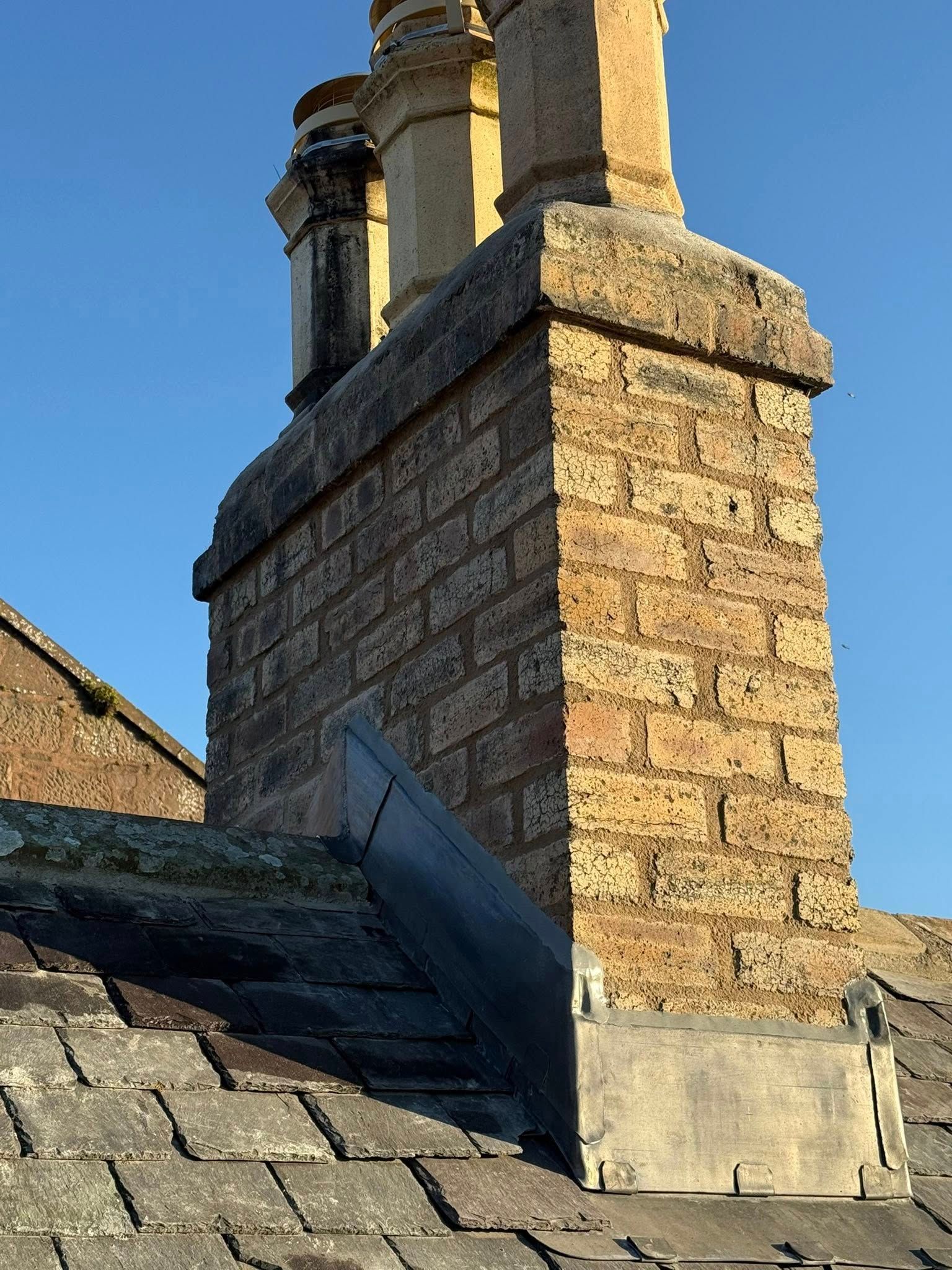
Lead flashing is the sheet metal weatherproofing at the junction between your chimney stack and the roof slope. It is the single most common cause of chimney-related leaks in Derbyshire homes — and it is frequently misdiagnosed as a general roof leak.
There are several components to a correctly fitted chimney flashing system:
- Front apron — the lead sheet across the front (downslope) face of the stack
- Side flashings (soakers and cover flashings) — the stepped lead detailing up each side of the stack
- Back gutter — the lead channel at the rear of the stack collecting water running down the roof slope behind the chimney
When any of these fails — lifting, cracking, or pulling away from the brickwork — water enters the junction and travels into the roof space or directly into the ceiling below. On older properties, mortar fillet flashings are sometimes found in place of lead. These are a short-term solution that always deteriorates faster than proper leadwork.
We repair and replace chimney flashing using Code 4 lead as a minimum — the correct specification for residential chimney flashing in the UK. We chase the lead into a mortar joint in the brickwork, fix it with lead wedges, and seal it correctly. Where the existing flashing has simply lifted or pulled loose from the pointing, we re-fix and re-seal rather than replacing the whole run unnecessarily.
Homes in Ripley and South Wingfield — where the same period property stock is common — see this repair regularly. If your Swanwick home has had no chimney maintenance for a number of years, lead flashing condition is the first thing we check.
Chimney Liner Installation and Removal for Properties Near Alfreton
Liner Installation
If you are converting an older open fireplace to a wood burner or solid fuel stove, a flue liner is likely to be required. Many older Swanwick properties have wide, unlined brick flues that were built for open fires. These are too large in diameter for a modern stove to work correctly — and the flue gases from a stove would attack an unlined brick flue over time.
A flexible stainless steel liner brings the flue diameter down to the size required by the appliance, protects the existing brickwork from condensation and flue gases, and allows the stove to draw correctly. This is HETAS-registered work and is self-certifying under building regulations. You do not need to make a separate notification to Amber Valley Borough Council in most cases — we handle the compliance documentation as part of the installation.
This service is relevant for properties across Swanwick where older fireplaces are being converted for modern appliances, including on the newer Swanwick Fields development where some properties include log burner installs that need proper flue specification from the outset.
Chimney Removal
Where a chimney stack is no longer in use and is beyond economical repair, removal may be the most sensible option. We carry out partial and full chimney stack removals, including making the roof watertight again after the stack is taken down. This involves removing the stack to below roof level, cutting and repairing the roof slope where the chimney passed through, and leaving a clean, weatherproof finish.
Full removal is worth considering when a stack has no active flue, has been neglected for many years, and the cost of repair would match or exceed the cost of removal and roof make-good. We will tell you honestly which option makes sense for your property after we have looked at it.
Booking a Chimney Repair in Swanwick — What to Expect
Booking a chimney repair with Derby Roofers is straightforward. Here is what happens from first contact through to completion.
Step 1 — Call us Ring 01332-529704 or use the contact form at derbyroofers.co.uk. Tell us your address, the type of property, and what you have noticed. We will ask a few quick questions about the chimney to understand the scope of the job.
Step 2 — Survey visit For chimney repair work we always carry out a survey first. This lets us inspect the stack properly — from ground level and, where needed, from roof level — and give you an accurate, itemised quote. There is no charge for a survey or quote.
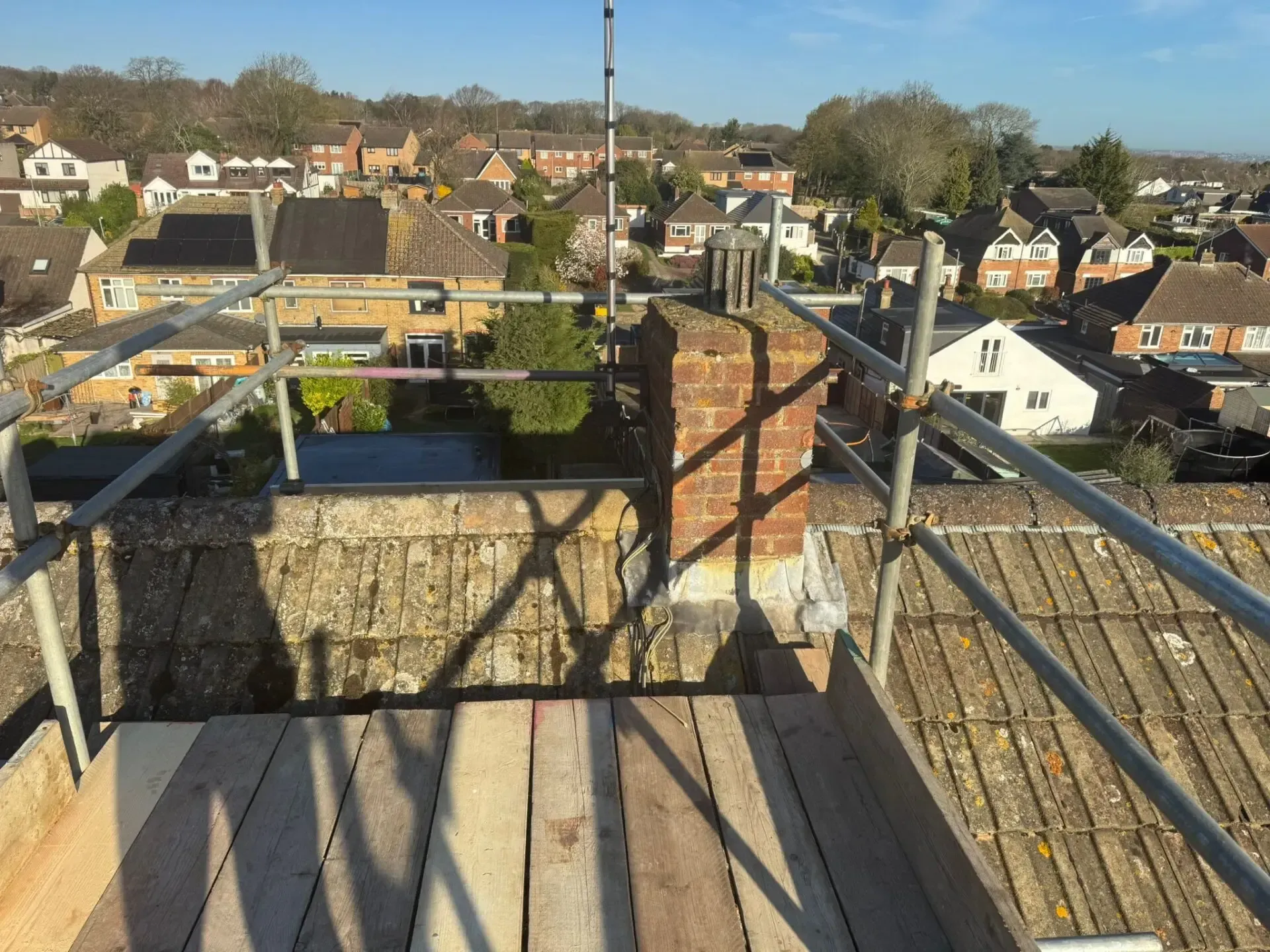
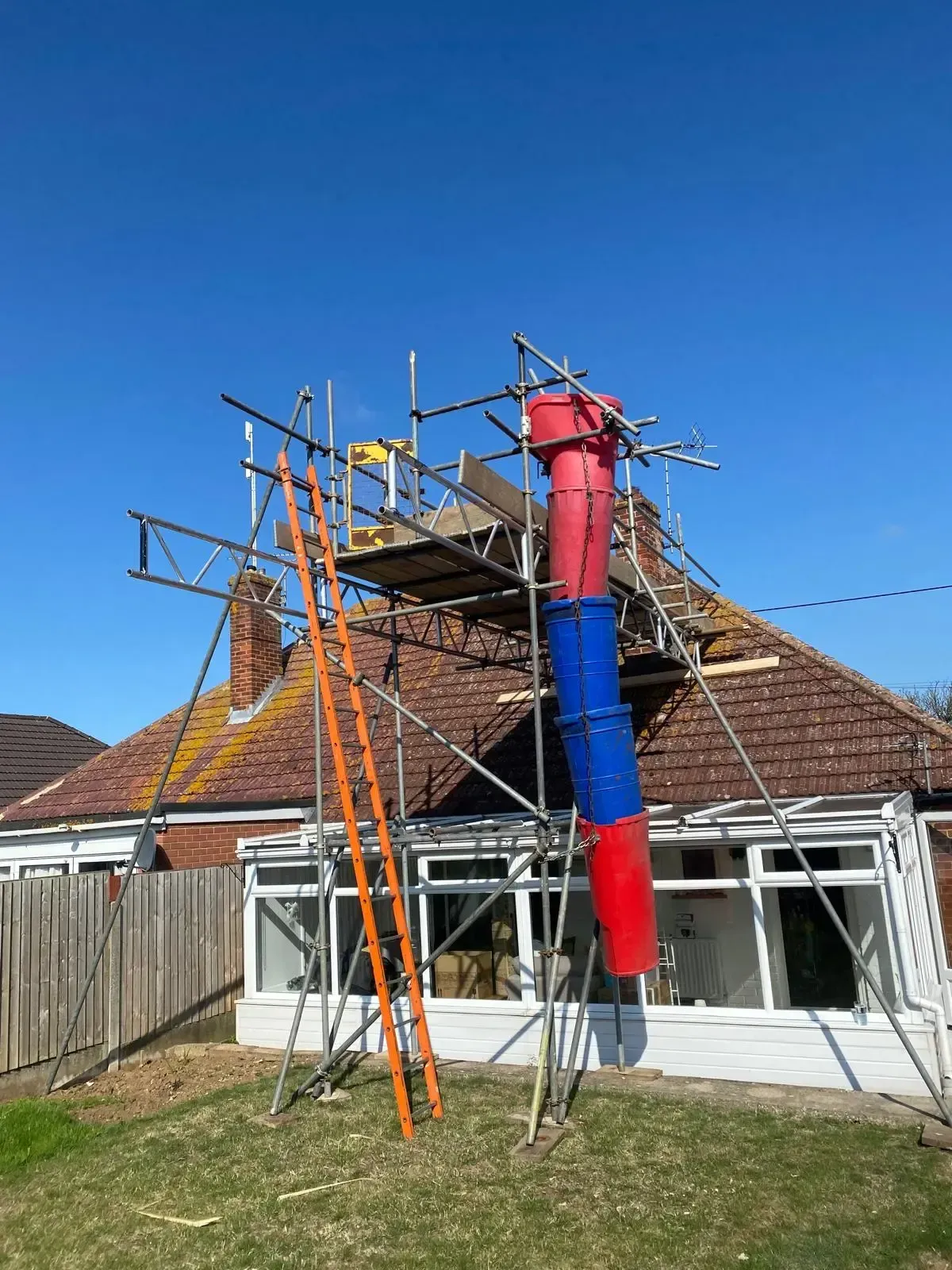
Step 3 — Scaffolding and access Chimney stack work requires safe working access. We arrange scaffolding as part of the job where needed. For properties on quiet residential streets in Swanwick — including the many cul-de-sac bungalow locations and detached family homes — access and parking are rarely an issue. If you are on a narrow street near the old village centre, let us know and we will plan the access ahead of the visit.
Step 4 — The repair We carry out the work as quoted, using materials suited to your property type. All chimney repairs come with a written guarantee.
Step 5 — Sign-off Once the work is complete we walk you through what was done. If we spotted anything else during access — a tile condition issue, a gutter problem — we will flag it while we have visibility, without any obligation to proceed.
When to book Autumn is the busiest time for chimney repairs across Amber Valley. If you want work done before winter, booking in spring or summer means more flexibility on dates. We cover the full DE55 postcode and regularly visit Leabrooks, Ironville, Codnor, and South Wingfield in the same run as Swanwick.
How to Find Us — Getting to Swanwick from Our Loscoe Base
Derby Roofers is based at Loscoe Grange, Loscoe, Heanor, DE75 7JY. We travel to Swanwick regularly and the route from our base is direct.
Directions from Loscoe to Swanwick:
- From Loscoe Grange, head south on the A608 towards Heanor town centre
- Pick up the A610 heading west from Heanor towards the A38
- Join the A38 southbound at the Ripley junction
- Take the Swanwick junction from the A38 — look for the turn just south of the former colliery site, now the industrial estate where the Thornton's factory stands
- From the junction, the village centre and most residential streets are within a few minutes
M1 Junction 28 is under five minutes from Swanwick via the A38. This means we cover the wider Amber Valley villages in the same journey. Properties in Leabrooks are accessed via the B6016 east of Swanwick. Somercotes is a few minutes further north on the A38.
Frequently Asked Questions
Can you repair chimneys on older Victorian terraced homes in Swanwick?
Yes. We work on older properties across Swanwick and Alfreton regularly. Victorian terraced and semi-detached homes on streets like High Street and South Street often have original brick stacks with deteriorated lime mortar. We use the correct mortar mix for the brickwork type — using a modern hard cement mix on soft Victorian brick causes more damage over time than it fixes.
Do I need scaffolding for chimney repointing or flashing repair?
In most cases, yes. Safe access to a chimney stack requires scaffolding. We arrange and include this as part of any chimney repair job where it is needed. It is a cost worth factoring in, and any reputable roofing contractor will build it into their quote rather than skipping it.
What is flaunching and why does it need replacing?
Flaunching is the mortar bed at the top of the chimney stack that holds the chimney pots in place and sheds rainwater off the crown. When it cracks or sinks, pots become unstable and water pools at the top of the stack. We remove failed flaunching completely and re-bed from scratch — patching over old flaunching is a short-term fix that fails again quickly.
My ceiling is damp near the chimney breast — is that a chimney repair job?
Often yes. Damp near the chimney breast is frequently caused by failed lead flashing at the roof junction, cracked flaunching, eroded mortar joints, or a combination of all three. It is sometimes misidentified as a general roof leak. We inspect the chimney and the surrounding roof area to find the actual source before recommending any repair.
Can you remove a chimney stack that is no longer in use?
Yes. We carry out partial and full chimney stack removals and make the roof watertight after the stack is taken down. This is worth considering when an unused stack is in poor structural condition and the cost of repair approaches or exceeds the cost of removal. We will give you an honest assessment of which option suits your property.
Do you cover Leabrooks, Somercotes, and South Wingfield as well as Swanwick?
Yes — all three areas fall within the same DE55 run and we cover them regularly. If you are in Leabrooks near the B6016 or in Somercotes further north on the A38 corridor, we serve your area.
How far in advance should I book a chimney repair in the Swanwick area?
Autumn slots fill quickly across Amber Valley from September onwards. If you want chimney work completed before winter, booking during spring or summer gives you more date choice and faster access to scaffolders. Storm damage repairs are handled as a priority where safety is at risk.