Fascias, Soffits and Guttering: Materials and When to Replace Them
What Are Fascias, Soffits and Guttering — and What Do They Do?
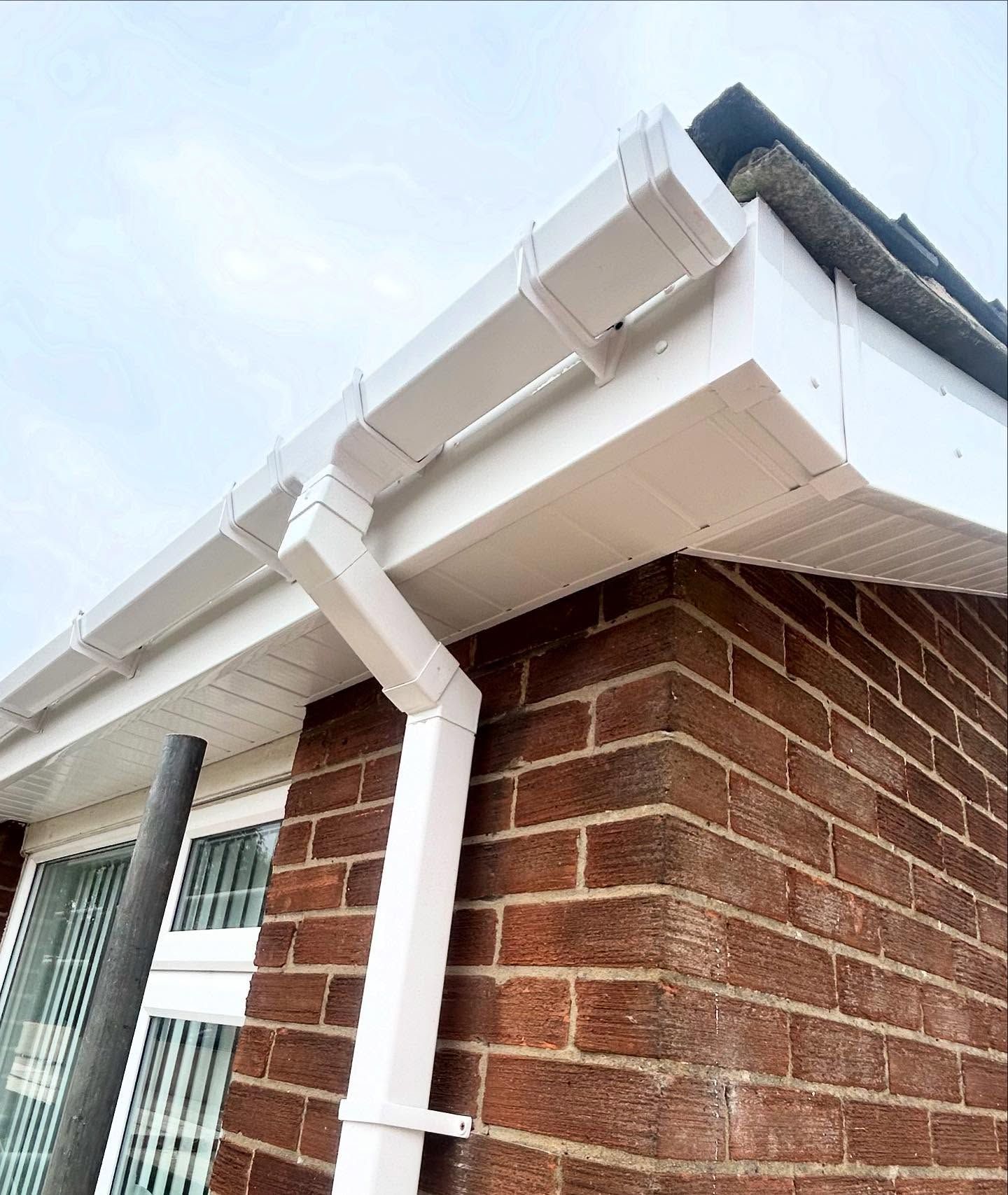
Your roofline is made up of four main components: fascia boards, soffits, bargeboards, and guttering. Each one does a different job. Together, they protect your roof structure, manage rainwater, and keep pests out of your loft.
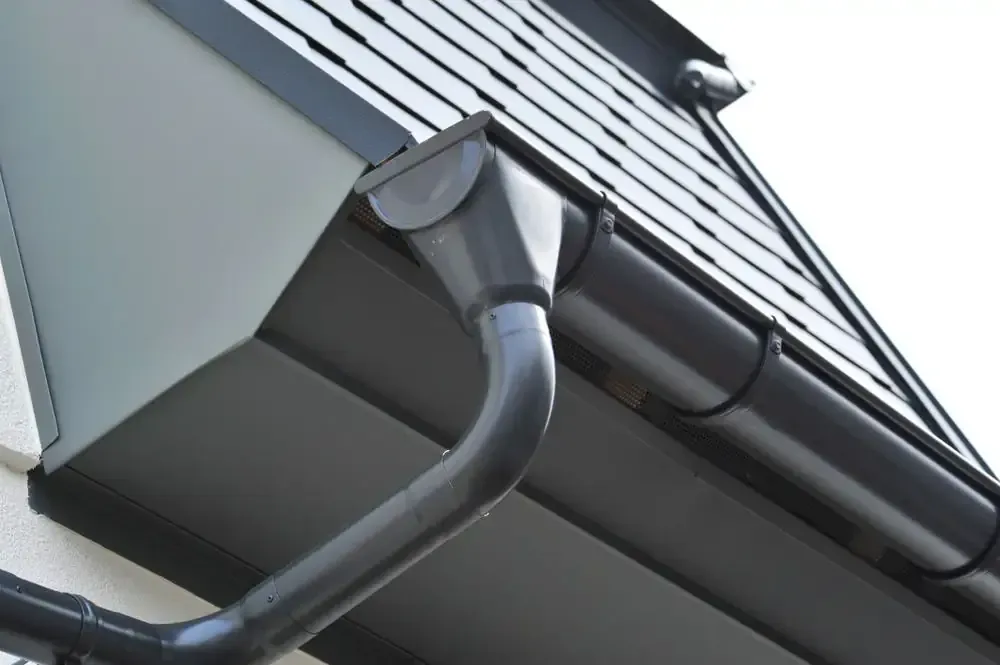
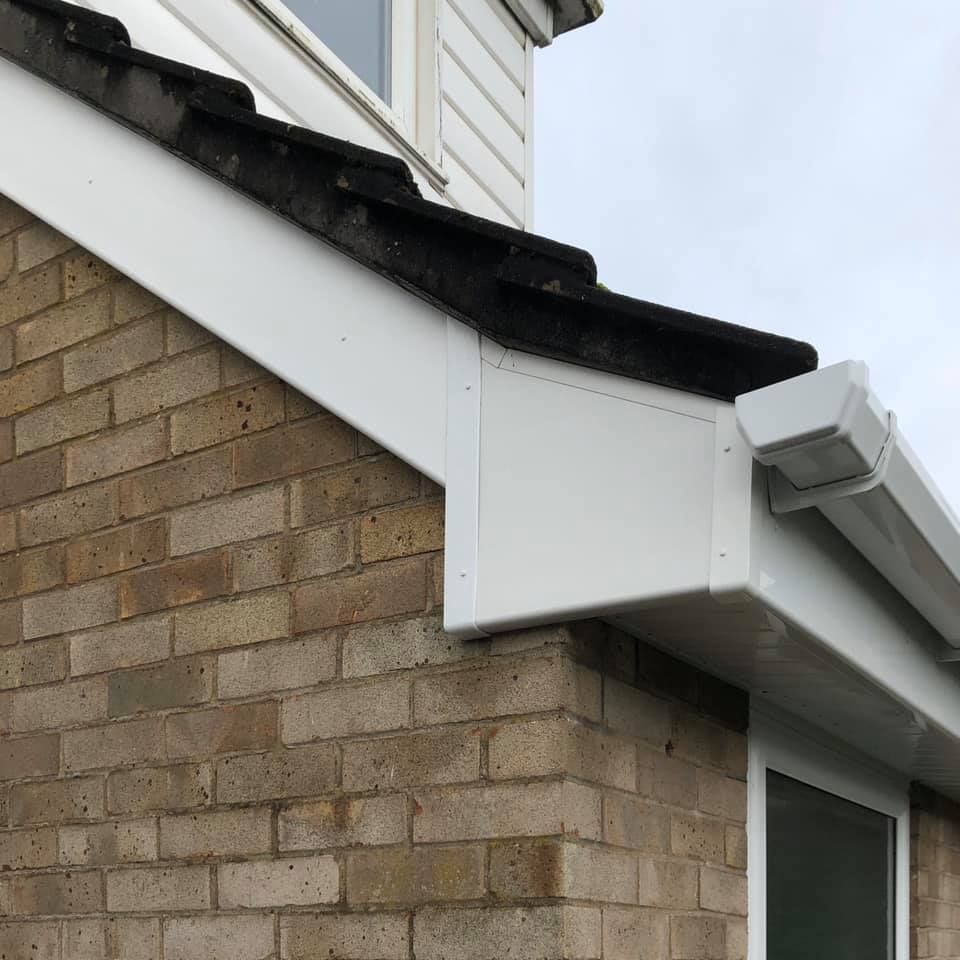
The fascia board runs horizontally along the lower edge of your roof. It caps the ends of the roof rafters and carries the full weight of your guttering. On a wet Derbyshire day, that guttering holds a significant volume of water — the fascia board takes all of that load.
The soffit sits underneath the fascia, bridging the gap between the fascia board and the outer wall of your house. It protects the underside of your roof from moisture and, when correctly ventilated, allows fresh air to circulate through the roof void. Without that airflow, condensation builds up in your loft and causes timber rot over time.
The bargeboard does the same job as the fascia board, but on the sloping gable end of the roof rather than the horizontal eave. It is often overlooked during maintenance — but when it fails, water tracks into the roof structure along the gable edge.
Guttering and downpipes collect rainwater from the roof surface and channel it away from your walls and foundations. A blocked or leaking gutter does not just look untidy. It saturates the fascia board behind it, causes damp patches on external walls, and, over time, can lead to water finding its way into your roof void and your property.
Across Derby, we see the consequences of neglected rooflines on a regular basis — on Victorian terraces in Normanton, post-war semis in Mickleover, and 1970s estates in Mackworth. The damage is almost always avoidable. The roofline system works quietly until one component fails, and then the others follow.
What Materials Are Used for Fascias, Soffits and Guttering in the UK?
The material your roofline is made from affects how long it lasts, how much maintenance it needs, and what it costs to replace. Here is a straightforward breakdown of the main options.
uPVC
uPVC is the most widely used material for fascias, soffits and guttering on residential properties across Derby and Derbyshire. It does not rot, does not need painting, and handles Derby's wet winters and freeze-thaw cycles reliably. A correctly installed uPVC roofline system typically lasts 20 to 30 years. All materials we install are BBA approved.
uPVC is available in a range of colours including white, black, brown, anthracite grey, and wood-effect foiled finishes. For most Derby homeowners replacing an ageing timber roofline, uPVC is the practical, cost-effective choice.
Timber
Timber is the traditional roofline material. You will still find it on many older properties across Derby, particularly on Victorian and Edwardian terraces in areas like Darley Abbey, Spondon, and Derby city centre. Timber can be painted to match your property and is accepted in some conservation areas where uPVC is not appropriate.
The drawback is maintenance. Timber fascias and soffits need repainting annually to stay waterproof. Once moisture gets behind the paint surface, rot sets in quickly — and rot in the fascia boards means rot in the rafter ends behind them. We always carry out a full rafter inspection when we remove old timber boards.
Aluminium
Seamless aluminium guttering is formed on-site as a single continuous run with no mid-run joints. Fewer joints mean fewer failure points. Aluminium handles Derbyshire's freeze-thaw cycles well and lasts significantly longer than uPVC guttering — typically 30 to 40 years. It is a strong choice for homeowners who plan to stay in their property long-term.
Cast Iron
Cast iron guttering is the right material for period properties and properties within Derby's conservation areas. It is heavy, requires repainting every five to ten years, and costs more to install than uPVC. But it is extremely durable, and for a Victorian terrace in Normanton or a period property near Derby city centre, it keeps the character of the building intact.
If your property has original cast iron guttering, we can assess whether it is worth maintaining or whether replacement — like-for-like in cast iron, or in a modern material — is the better route.
Finlock and Concrete Gutters
Finlock concrete gutters were fitted to thousands of Derby and Derbyshire homes built in the 1940s, 1950s, and 1960s. You will find them on many of the properties on estates in Chaddesden, Spondon, and Alvaston from that era. They are no longer repairable in any meaningful sense. Concrete gutters absorb water, crack along their length, and cause persistent damp problems inside the property — often appearing as staining on upper bedroom ceilings.
We carry out full Finlock removal and replace with either a seamless aluminium or uPVC system, including any brickwork reinstatement required after the concrete is taken out.
How Do You Know When Fascias, Soffits and Guttering Need Replacing?
The warning signs are usually visible from ground level if you know what to look for. Walk around your property after heavy rain and check the following.
Signs your fascias need replacing:
- Soft or spongy timber boards when pressed — this is active rot
- Dark staining, crumbling edges, or paint that flakes repeatedly
- Boards pulling away from the rafter ends
- Visible cracks or gaps where the fascia meets the soffit
Signs your soffits need replacing:
- Discolouration or staining visible from below
- Birds, wasps, or insects entering at the eaves — a gap in the soffit is letting them in
- Increased humidity or a musty smell in your loft — blocked soffit ventilation causes this
- Cracked soffits on pre-1980s properties: stop and call us before removing anything. Older properties in Derby can have asbestos soffit boards. Asbestos materials require a licensed contractor to remove safely.
Signs your guttering needs replacing:
- Overflow during rain — water running down the outside wall, not through the downpipe
- Visible cracks, splits, or holes along the gutter run
- Gutters sagging between brackets or pulling away from the fascia
- Rust staining on brickwork below the gutter line
- Joints that have failed and been repaired more than once
- Moss or plant growth inside the gutter channel
On older terraced streets in Normanton and Sinfin, we regularly find cast iron gutters that have been patching the same sections for years. Once you are repairing the same joint more than once, replacement is nearly always the better decision financially.
We include a free roofline inspection with every new enquiry. We tell you what the boards and gutters actually need — not what costs the most.
How Much Does It Cost to Replace Fascias, Soffits and Guttering in Derby?
Cost depends on your property size, the materials you choose, and what condition the underlying structure is in when we remove the old boards. Here is a practical guide.
General cost guide for Derby properties (uPVC, full replacement):
- Terraced house (front and rear): from around £1,500 to £2,200
- Semi-detached (three sides): from around £2,500 to £3,500
- Detached house (four sides): from around £3,800 upwards
These figures cover the full roofline — fascias, soffits, bargeboards, and guttering — using BBA-approved uPVC materials. They include removal and disposal of the old system. Scaffolding, where needed, is an additional cost and depends on your property's height and access.
What affects the final price:
- Material choice — seamless aluminium and cast iron cost more than uPVC
- Whether rafter ends need repair once the old boards are off
- Scaffolding requirements — for most two-storey Derby properties, tower scaffolding or a full scaffold is needed for safe access
- Whether your property is in a conservation area or is a listed building — this can restrict material choices and require additional consultation
Cap-over vs. full replacement:
Some contractors offer to cap new uPVC boards directly over your existing timber, without removing the old material. This is cheaper in the short term. It is not something we offer or recommend. Capping over rotten timber traps moisture and accelerates the deterioration of the boards behind. It also makes it impossible to inspect the rafter ends — which is exactly what we need to check once the old fascias come down. Full replacement costs more upfront and lasts significantly longer.
We provide a free, itemised written quote before any work starts. You know exactly what you are paying for.
Is It Better to Cap Over Fascias and Soffits or Fully Replace Them?
We get asked this regularly. The answer depends on the condition of your existing timber — but in most cases we see across Derby, full replacement is the right call.
When capping might seem attractive:
- Lower upfront cost
- Faster job
- Less disruption
Why we always remove and replace:
When we take off the old fascia boards, we expose the rafter ends behind them. On a significant proportion of Derby properties — particularly on housing stock from the 1960s, 1970s, and 1980s — those rafter ends show signs of moisture damage or early rot. If we had capped over the old boards, that rot would have continued spreading, unseen, for years.
Fitting new uPVC boards over rotten timber also means the new fascia is not fixed securely. Gutter brackets need a sound fixing point to hold the weight of a full gutter system in wet weather. Soft timber does not provide that.
We inspect every rafter end once the old boards are removed. If we find damage, we address it before the new boards go on. That is the only way to give you a roofline that will last 20 to 30 years.
How Long Do uPVC Fascias, Soffits and Guttering Last?
A correctly installed uPVC roofline system will typically last 20 to 30 years. The key words are "correctly installed." The fall angle on the gutters, the bracket spacing, the over-fascia ventilation, and the quality of the boards all affect how long the system performs.
Here is a straightforward guide by material:
- uPVC fascias and soffits: 20–30 years
- uPVC guttering: 20–30 years; older uPVC becomes brittle and joint seals dry out
- Seamless aluminium guttering: 30–40 years; fewer joints mean fewer failure points
- Cast iron guttering: 50 years or more with annual painting and joint maintenance
- Timber fascias and soffits: 10–15 years in UK conditions with regular maintenance; less without it
Every full installation we carry out includes over-fascia ventilation as standard. This keeps the roof void aerated and protects the new boards from the inside out. We also fit a bird comb along the eaves to prevent birds and pests from entering the roof space behind the new fascia.
Do You Need to Replace Guttering at the Same Time as Fascias and Soffits?
In most cases, yes. And for a practical reason: guttering is fixed directly to the fascia board. When we remove the fascia boards to replace them, the guttering comes off with them. Once it is off, we can assess its condition properly.
If the guttering is in good condition, we refit it to the new boards. If it is cracked, brittle, sagging, or has multiple failed joints, replacing it at the same time makes sound financial sense. Access costs money. Paying for tower scaffolding or a full scaffold once, rather than twice in the space of two or three years, is a more efficient use of your budget.
On most Derby semi-detached properties, combining gutter replacement with fascia and soffit work in one visit is more efficient and gives the full roofline a clean, consistent finish. It also removes the risk of fitting new gutters to fascia boards that are already beginning to fail behind them.
Can You Replace Fascias, Soffits and Guttering Yourself?
You can replace guttering at ground-floor level with some DIY confidence and the right tools. For anything on a two-storey Derby property, working at height is the main risk. Falls from ladders account for a significant number of serious injuries in home improvement work every year.
Beyond the height risk, the technical details matter more than they appear. Soffits fitted without the correct ventilation gap block the airflow into your roof void. That causes condensation, damp, and eventually timber rot in the roof structure — damage that costs far more to put right than the job itself.
Fascia boards need to be fixed to sound rafter ends. If the rafter ends are already soft and you do not spot it, the new boards are not properly secured. The gutters that hang from them will sag or pull away within a season.
For pre-1980s Derby properties, there is also the asbestos risk. Older soffit boards on properties from that era can contain asbestos insulating boards. You cannot tell by looking at it. If you have any doubt about the age of your soffits, call us before you start removing anything. We can check this for you.
For a straightforward one-storey structure in good condition, DIY may be an option. For the vast majority of Derby homes, professional installation gives you a roofline that is correctly ventilated, securely fixed, and backed by a workmanship guarantee.
Do You Need Scaffolding to Replace Fascias, Soffits and Guttering in Derby?
For most two-storey Derby properties, some form of safe access platform is needed. This usually means either mobile tower scaffolding or a full scaffold, depending on the height, roof geometry, and access around the property.
A single-storey extension or garage roof can often be reached safely with an industrial ladder stabiliser and the right equipment. We carry out a risk assessment on every job before work begins.
Scaffolding is typically an additional cost on top of the roofline materials and labour. We include this assessment in our free survey and quote it as a separate line so you can see exactly what you are paying for. We do not hide access costs inside a single lump sum.
For larger Derby properties or where multiple sides need access, we arrange scaffolding to cover the full job in one erection and strike. That keeps disruption to a minimum and avoids the cost of bringing it back out a second time.
How Do You Maintain Fascias, Soffits and Guttering to Make Them Last?
New roofline boards and gutters require very little maintenance. A few simple habits will significantly extend their life.
Annual gutter clearance: Autumn is the most important time to clear your gutters in Derbyshire. Mature trees in areas like Allestree, Darley Abbey, and Duffield drop large volumes of leaves into gutter systems from October onward. A blocked gutter that carries standing water through winter is the fastest route to joint failure and overflow damage.
Inspect during rain: The only way to catch an overflowing gutter is to look at it while it is raining. Walk around your property after the next downpour and check where the water goes. If it runs down the wall rather than through the downpipe, you have found the problem.
Cleaning uPVC boards: Clean uPVC fascias and soffits with soapy water and a soft cloth. Never use solvent-based cleaners on coloured, foiled, or wood-effect uPVC — they strip the surface finish and void the product guarantee. White uPVC can be cleaned with a uPVC frame cleaner if it has become discoloured over time.
Timber maintenance: If your property still has timber fascias and soffits, inspect and repaint them every year. If you press a board with your thumb and it feels soft, painting over it will not fix it. Soft timber needs full replacement — the rot will spread behind any surface treatment.
Inspection frequency: A visual check twice a year — spring and autumn — is sensible for most Derby homeowners. After a hard Derbyshire winter, it is worth checking all four sides of the property for any joints that have moved, any boards that have shifted, and any overflow points in the guttering.
Frequently Asked Questions — Fascias, Soffits and Guttering in Derby
What is the difference between a fascia and a soffit?
The fascia is the vertical board that runs along the lower edge of the roof and carries the guttering. The soffit is the horizontal board underneath it, bridging the gap between the fascia and the outer wall and providing ventilation to the roof void. Both boards work together as part of the full roofline system.
How much does it cost to replace fascias and soffits on a semi-detached house in Derby?
A full uPVC replacement on a typical Derby semi-detached house — covering three sides, including fascias, soffits, bargeboards, and guttering — generally costs in the range of £2,500 to £3,500. Scaffolding and any rafter repairs needed once the old boards are removed are additional costs. We provide a free, itemised written quote for every job before any work begins.
Do I need planning permission to replace fascias, soffits and guttering in Derby?
In most cases, no. Like-for-like replacements and upgrades of fascias, soffits and guttering on most Derby properties fall under permitted development rights. If your property is a listed building, or sits within a conservation area — such as parts of Derby city centre or Belper — different rules may apply. We check this as part of our free survey and advise you before any work starts.
How do I know if I have asbestos soffits?
Asbestos soffit boards were used on many properties built before 1980. You cannot identify asbestos by sight alone. If your property was built before 1980 and has never had the soffits replaced, treat them as potentially containing asbestos until tested. Call us before removing anything — we can advise on the correct approach and, where needed, arrange for a licensed contractor to carry out removal safely.
Can you replace guttering without replacing the fascias?
If the fascia boards are in sound condition, yes. We check the boards on every gutter job. If they are solid, we fit the new gutters directly to the existing fascia. If the boards are soft or showing rot, fitting new gutters to them is a short-term fix — the brackets will not hold securely in softwood. In that case, we will recommend sorting both at the same time.
How long does a roofline replacement take on a Derby property?
Most Derby terraced houses are completed in one to two days. A semi-detached property typically takes two to three days. A larger detached home may take three to five days, depending on how many sides need access and whether fascia, soffit, bargeboard, and gutter work are all combined. We give you a clear timeframe before work begins.
Do Derby Roofers replace old fascias completely or cap over them?
We always remove and replace — we do not offer cap-over installations. Fitting new uPVC boards over existing timber without removing it makes it impossible to inspect the rafter ends for rot. It also reduces ventilation to the roof void and creates a double layer of boards that is not fixed securely. Full replacement is the only method we use.
Fascias, Soffits and Guttering Replacement in Derby — Get a Free Quote
Damaged roofline boards and failing gutters will not improve on their own. Every season they are left, water is doing work you cannot yet see — in the roof void, behind the fascia boards, and on the walls and foundations below.
Derby Roofers carries out free, no-obligation roofline inspections across Derby and Derbyshire. We use a free drone survey where needed, so you get a clear picture of your full roofline before you decide anything. We check fascias, soffits, bargeboards, guttering, downpipes, and the rafter ends behind the boards. We give you a written assessment and a fully itemised quote.
We cover Derby city centre (DE1), Allestree, Mickleover, Littleover, Normanton, Chaddesden, Spondon, Alvaston, Borrowash, Long Eaton, Belper, Ilkeston, Heanor, Ripley, and throughout Derbyshire.
Call us on 01332-529704 or complete our contact form at derbyroofers.co.uk/contact-derby-roofers. We get back to you the same day.
Derby Roofers · Loscoe Grange, Loscoe, Heanor, DE75 7JY ·
01332-529704 · info@derbyroofers.co.uk