Derby Roofers
GRP Fibreglass Roof Specialists
Call us now book a FREE consultation and FREE Quotation
FREE Drone Survey Available
Call: 01332-529704
Do I Need Planning Permission for a GRP Flat Roof in Derbyshire?
Replacing a flat roof in Derby is one of the most straightforward roofing jobs there is — until the question of planning permission comes up. Most Derby homeowners stop in their tracks. They want to get the job done, but they don't want to get it wrong.
The short answer for most properties is no — you do not need planning permission for a GRP flat roof replacement in Derbyshire. Replacing a like-for-like flat roof covering falls under permitted development rights in England. No application, no fee, no wait.
But there are exceptions. Some are obvious. Others are specific to Derbyshire — and almost no roofing contractor in the Derby area addresses them directly.
This guide covers planning permission for GRP flat roofs in Derby and Derbyshire in full. We cover the national rules, the local exceptions, building regulations, and the Derbyshire-specific situations — conservation areas, Article 4 Directions, post-war housing stock — that can change the picture. By the end, you'll know exactly where your property stands.
We deal with these questions on jobs across Derby, Belper, Long Eaton, and Heanor every week. If you'd rather just ask us directly, call 01332-529704 for a free survey and honest answer — no pressure.
The Quick Answer — GRP Flat Roof Replacement and Permitted Development Rights
Permitted development rights allow certain home improvements to go ahead without a formal planning application. They are granted automatically under the Town and Country Planning (General Permitted Development) (England) Order 2015.
Replacing a flat roof covering — including swapping old felt or bitumen for GRP fibreglass — is permitted development. You are changing the waterproofing material, not the structure, footprint, or height of the building in any significant way.
In most cases, replacing a flat roof with GRP in Derbyshire:
- Does not require a planning application
- Does not require you to notify Derby City Council's planning department
- Can proceed once you have confirmed your property is not in a restricted area (see below)
You likely do NOT need planning permission if:
- You are replacing an existing flat roof covering on a house, extension, or garage
- The structure is not changing
- The finished roof height increases by less than 150mm
- Your property is not a listed building
- Your property is not in a conservation area subject to an Article 4 Direction
You likely DO need planning permission if:
- Your property is a listed building
- You are in a Derbyshire conservation area with an Article 4 Direction in force
- The new roof raises the building height by more than 150mm
- You are adding a roof terrace or balcony
- You are building a new extension with a flat roof (the extension itself needs permission)
We survey your property before every GRP installation. Where there is any question about planning constraints, we flag it at the survey stage — before any work is booked. Call 01332-529704 or visit derbyroofers.co.uk/contact-derby-roofers to arrange your free inspection.
Planning Permission vs Building Regulations — What's the Difference?
These are two separate systems. Mixing them up is the most common mistake Derby homeowners make — and it leads to either skipping something important or worrying about something that doesn't apply.
Planning permission is about what you build and how it looks. It is controlled by your local planning authority — Derby City Council for city properties, or Derbyshire Dales, South Derbyshire, or Amber Valley councils for properties outside the city. It considers the impact on neighbours, the street, and the local area.
Building regulations are about how safely and efficiently something is built. They cover structural strength, fire safety, insulation, and drainage. In Derbyshire, building regulations are enforced by DBCP — the Derbyshire Building Control Partnership — which covers Derby City, NE Derbyshire, Derbyshire Dales, Bolsover, and Amber Valley.
Here is the key point most Derby homeowners miss:
You can need one without needing the other. For a GRP flat roof replacement, building regulations almost always apply — even when planning permission does not.
Planning permission — usually not required for a like-for-like GRP replacement. Building regulations — almost always required, regardless of whether planning applies.
Skipping building regulations causes problems at property sale. Solicitors' searches pick up missing completion certificates. Buyers flag it, and deals fall through. It is a more common issue than planning enforcement on domestic flat roofs.
We advise on both as part of every free survey we carry out across Derby and Derbyshire. Call 01332-529704 or visit derbyroofers.co.uk/contact-derby-roofers to book yours.
When Do You Need Planning Permission for a GRP Flat Roof? Five Trigger Scenarios
These are the five situations that require a planning application before GRP flat roof work can begin in Derbyshire.
1. Your property is a listed building. Any external alteration to a listed building — including a roof material change — requires Listed Building Consent. This applies regardless of whether the building is Grade I, II*, or Grade II. Listed Building Consent is separate from planning permission, but in practice you almost always need to apply for both. South Derbyshire, Derbyshire Dales, and parts of Derby city have significant listed building stock. If you are unsure of your listing status, check the Historic England register at historicengland.org.uk.
2. Your property is in a Derbyshire conservation area with an Article 4 Direction. This is the scenario most roofing contractors miss entirely — and it is highly relevant to Derbyshire. See the full section below on Article 4 Directions.
3. The new roof raises the building height by more than 150mm. This is most relevant when upgrading a cold roof to a warm roof system. A warm roof places insulation above the existing deck, which adds height. If that addition exceeds 150mm above the existing roof surface, planning permission is required. On most domestic extensions and garages in Derby, the insulation addition stays within this limit — but it should always be measured, not assumed.
4. You are adding a roof terrace or balcony. Converting any flat roof into a usable terrace or balcony always requires a full planning application. It is a change of use and creates overlooking opportunities for neighbouring properties — a material planning consideration. Derby City Council will assess the impact on neighbours and the character of the area.
5. You are building a new extension with a flat roof. Planning permission relates to the extension itself, not solely the roofing material. If the extension is new construction, permitted development rules for extensions apply — size limits, height limits, and distance from boundaries all matter. Our team advises on this at the survey stage for any new extension project.
For a free assessment of your specific property, call us on
01332-529704. We check planning constraints before quoting on every job across Derby, Normanton, Allestree, Chaddesden, and the wider Derbyshire area.
The 25% Rule — When Building Regulations Are Triggered for GRP Flat Roofs
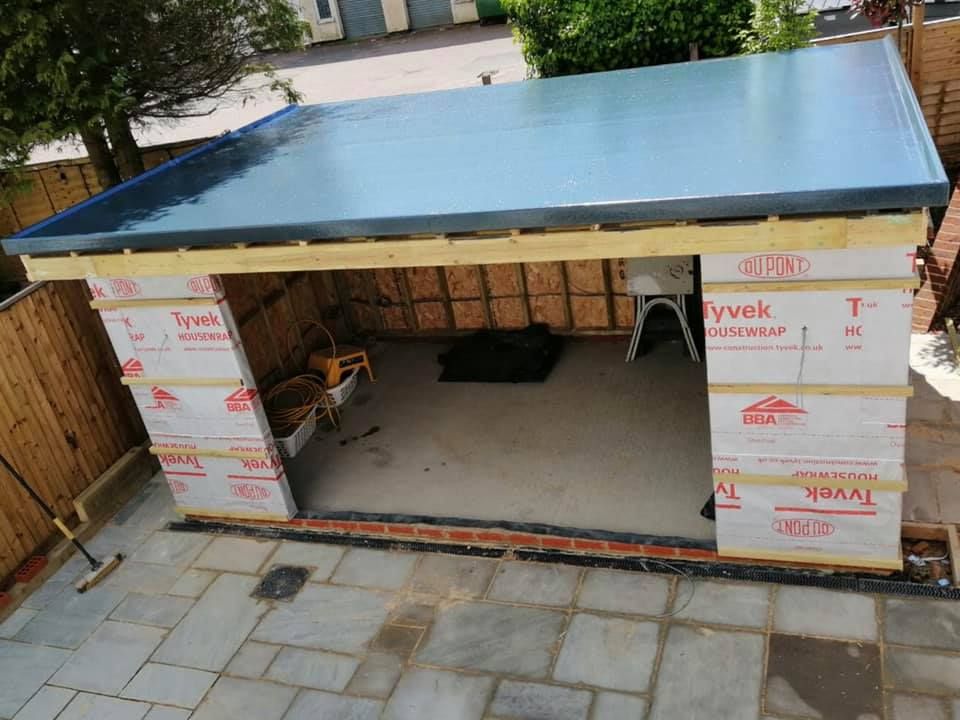
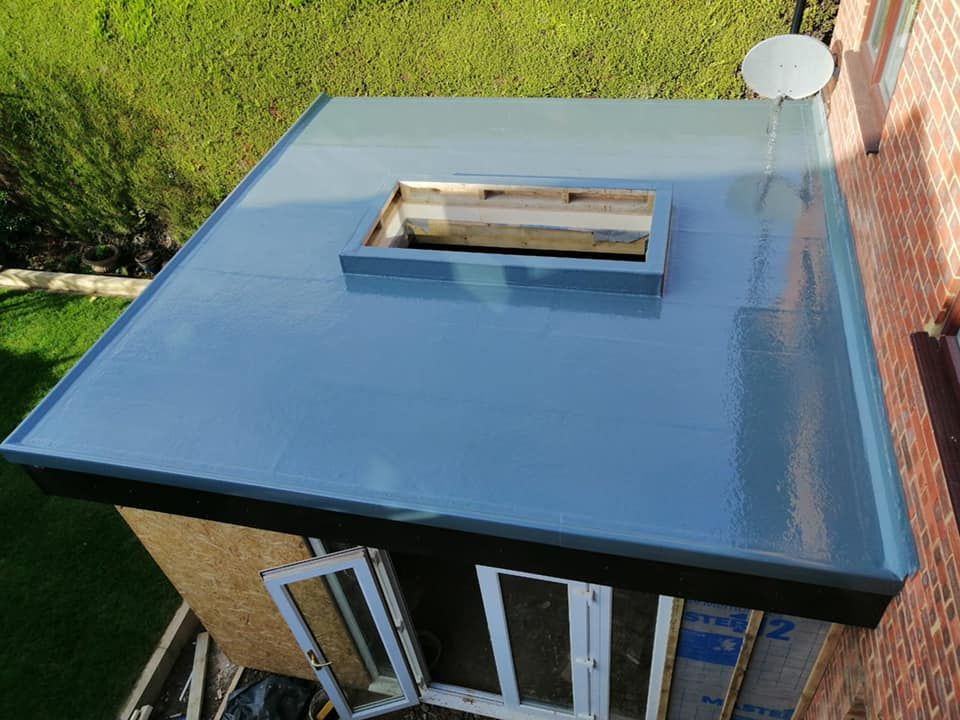
If you replace more than 25% of your total building envelope — that includes walls, roof, floor, windows, and doors — the full requirements of Part L of the Building Regulations apply. For a whole flat roof replacement on a garage, extension, or house, you are almost certainly above that threshold.
What Part L requires for a flat roof in England:
- A maximum U-value of 0.18 W/m²K
- This is met by installing insulation of sufficient depth — typically achieved with a warm roof configuration using PIR insulation boards above the deck
Warm roof vs cold roof — why it matters for Derby properties: A warm roof places insulation above the existing deck, beneath the GRP membrane. It meets Part L more cleanly, eliminates the condensation risk of cold roof designs, and improves the property's Energy Performance Certificate. A cold roof places insulation between the joists, requires cross-ventilation, and must maintain a 50mm air gap above the insulation — something that is frequently omitted on older Derby properties.
On every flat roof survey we carry out in Derby and across Derbyshire — whether that is a 1970s garage in Normanton, a kitchen extension in Mickleover, or a commercial flat roof on Alfreton Road — we assess the existing insulation depth and flag where Part L compliance is needed. Not every roofer includes this as standard.
DBCP self-certification: Contractors registered under a competent person scheme can self-certify Part L compliance without a separate building notice. This reduces delay and paperwork. Ask any roofer you are considering whether they can self-certify — or whether you will need to submit a separate building notice to DBCP.
If you skip building regulations notification:
- Your installation warranty may be invalid
- Building regulations compliance documentation will be missing when you sell the property
- Solicitors' searches will flag the gap, and buyers can and do walk away
- In some cases, DBCP can require the work to be opened up for inspection retrospectively
Rule of thumb: if you are replacing the whole flat roof, assume building regulations apply. Budget for an insulation upgrade and factor in the notification route when getting quotes. We price both warm roof and cold roof configurations on every Derby flat roof survey and present the options clearly.
Conservation Areas and Article 4 Directions — The Derbyshire Rules Most Roofers Never Mention
This is where Derbyshire diverges from the national standard — and where most roofing contractors leave Derby homeowners uninformed.
What is an Article 4 Direction? An Article 4 Direction is made by a local planning authority to withdraw permitted development rights in a specific area. In plain terms: it means work that would normally not need planning permission — including a like-for-like roof covering change — now requires a formal planning application.
Where Article 4 Directions apply in Derbyshire:
- Matlock Bath Conservation Area — an Article 4 Direction has been in force since 1991. It covers properties on North Parade, South Parade, and part of Dale Road. Any alteration to roof covering — including a straight GRP-for-felt replacement — requires planning permission under this direction.
- Osmaston Conservation Area — an Article 4 Direction covers four historic properties in this area (Coronation Cottages). Roof material changes require planning permission.
- Derby City conservation areas — Derby City Council confirms that Article 4 Directions have been applied within the city's conservation areas to protect their character. If your property is within a Derby city conservation area, check whether an Article 4 Direction applies before booking any roof work.
- South Derbyshire has 22 designated conservation areas, each with additional planning controls. Check with South Derbyshire District Council for your specific area.
How to check your property:
- Derby City Council's planning constraints map: derby.gov.uk/environment-and-planning/planning/development-control/planning-constraints
- Derbyshire Dales Article 4 information: derbyshiredales.gov.uk/planning/conservation/article-4-direction
- The Planning Portal's property search also shows conservation area designations
The practical reality: Most GRP flat roof replacements in conservation areas are approved — it is the process that changes, not necessarily the outcome. You will need to submit a householder planning application and wait for determination. This adds time and a modest fee to the project. It does not mean the work cannot go ahead.
If your property sits within a Derby city conservation area, a Derbyshire Dales conservation area, or anywhere across the county where an Article 4 Direction may apply, tell us when you call. We include a planning constraint check as part of every free survey we carry out — from DE1 to DE75.
1960s and 1970s Derby Properties — Warm Roof Upgrades, Heights, and Boundaries
A large proportion of Derby's housing stock was built between 1960 and 1979 — the flat-roofed garages and rear extensions on semis across Spondon, Mackworth, Normanton, and Chaddesden. Most were finished in torch-on felt or early bitumen systems. Many of those roofs are now well past the end of their practical life.
When these properties are upgraded to GRP with a warm roof system, two questions come up that very few Derby roofing contractors think to ask.
Does a warm roof upgrade push the height over the 150mm threshold? A warm roof adds PIR insulation boards above the existing deck before the GRP goes down. The typical insulation depth to achieve the required U-value is 80–120mm on top of the existing deck. Add the GRP system itself and the increase above the original roof surface can be 100–150mm or more.
On most projects this stays within the permitted development limit. But it depends on what is already there — the depth of any existing insulation, the condition of the original roof build-up, and the height of existing upstands and parapets. We measure before we specify. On every job.
If you have an original 1960s or 70s flat roof in Spondon, Chaddesden, or Mackworth, book a free survey before you proceed with any quote. A roofer who hasn't measured the existing build-up cannot tell you with certainty whether you are within the 150mm limit.
Neighbour and boundary considerations: If the flat roof sits close to a party wall or shared boundary — common on the semi-detached stock across Alvaston and Littleover — a small increase in height can affect your neighbour's light or sightlines. Worth a brief conversation before work begins.
Where a flat roof abuts a shared wall, the Party Wall etc. Act 1996 may also apply. This is separate from planning permission and building regulations. If the work involves the party wall or its foundations, you may need to serve a Party Wall Notice on your neighbour before starting. We flag this at the survey stage.
Do You Need a Bat Survey Before Replacing a Flat Roof in Derbyshire?
This is the question no Derby roofing contractor is asking — but it is legally significant and can stop a job before it starts.
All bat species in the UK are strictly protected under the Wildlife and Countryside Act 1981 and the Conservation of Habitats and Species Regulations 2017. It is a criminal offence to disturb, injure, or kill a bat, or to damage or destroy a bat roost — even if the roost is not currently occupied.
Older flat roofs — particularly those on pre-1980s properties in Derbyshire — can provide roosting habitat. Bats access gaps at the soffit-fascia junction, under flat roof edge trims, or through small voids in the roof build-up. Derbyshire is known bat habitat, and Natural England enforces these protections.
Signs that bats may be using your roof:
- Bat droppings near the soffit or fascia line (small, dark, dry pellets)
- Staining on the soffit board below the roofline
- You have seen bats entering or leaving the eaves at dusk
- Previous reports of bats in the loft from surveys or neighbours
If any of these apply, commission an Initial Bat Roost Assessment (aIRA) from a licensed ecological surveyor before booking roofing work. If bats are confirmed, a European Protected Species licence from Natural England will be required before work can proceed.
This is not a rare situation in Derbyshire. We raise it with customers on surveys of older properties across Belper, Heanor, Matlock, and Bakewell where the bat habitat risk is higher. Addressing it before booking the job saves significant delay and legal exposure. Full guidance is available from Natural England at gov.uk/guidance/bats-protection-surveys-and-licences.
Converting a GRP Flat Roof into a Terrace — and Peak District Rules
If you want to use a flat roof as a terrace or balcony, the rules change entirely. This is not a material change — it is a change of use, and it always requires a planning application.
Why planning permission is always needed for roof terraces: A terrace creates direct overlooking onto neighbouring properties. That is a material planning consideration. Derby City Council will assess the impact on neighbours' privacy and the character of the street before granting permission. The application itself is straightforward in most cases — but it cannot be skipped.
If your property is in or near the Peak District National Park: The Peak District National Park Authority (PDNPA) is an independent planning authority. It operates separately from Derbyshire County Council and from Derby City Council. Properties on the Derbyshire side of the National Park boundary — including parts of Derbyshire Dales near Bakewell, Ashbourne, and Matlock — may fall within PDNPA jurisdiction rather than the district council's.
The PDNPA applies stricter controls than standard Derbyshire permitted development rules. Roof terrace and balcony applications within the National Park face greater scrutiny, and what would be approved elsewhere in Derbyshire may not be approved here.
If your property is in or close to the National Park boundary, seek pre-application advice from the PDNPA before commissioning any design or survey work for a roof terrace project. Their planning team can confirm jurisdiction and advise on likelihood of approval before you spend money on drawings. Visit peakdistrict.gov.uk/planning for current guidance.
What Happens If You Install a GRP Flat Roof Without Planning Permission?
The short answer: it depends on your situation, and in most cases the risk is manageable — but skipping the process where permission is actually needed creates real problems.
Planning enforcement in Derby is complaint-driven. Derby City Council deals with planning breaches reported by neighbours or members of the public. If nobody reports the work, enforcement action is unlikely on a simple flat roof replacement. However, if your work does require permission and a neighbour complains, the Council can investigate.
What enforcement looks like: Derby City Council can issue a Planning Enforcement Notice requiring you to undo the work or submit a retrospective planning application. Retrospective planning permission is a genuine option — it is not an admission of wrongdoing, and many applications are approved. But it adds cost, delay, and uncertainty, and the Council may impose conditions you would not have faced on a proactive application.
The bigger practical risk: selling your property. This is where homeowners most often feel the consequences. When you sell a Derby property, your solicitor's searches will reveal whether building regulations completion certificates exist. A flat roof replacement without the appropriate building regs documentation will show up. Buyers' solicitors will flag it. Buyers can — and do — pull out or renegotiate the price as a result.
Planning permission gaps can also be flagged at the same stage. Indemnity insurance is available in some cases, but it is a workaround, not a solution.
If you have already had the work done without permission:
- Check whether permission was actually required — not all flat roof replacements need it
- If permission was required, contact Derby City Council's Development Control team about a retrospective application: derby.gov.uk/environment-and-planning/planning/development-control/pre-application-advice-residents
- Get building regulations documentation in order through DBCP if the work was carried out without notification
We can advise you honestly on your situation during a free survey. If there is a planning question about your property, we will tell you before we quote — not after the job is done.
The Roof That Needed More Than a Quote — A Real Derby Job
A Customer Scenario — Neville Bradshaw. Mackworth, Derby
A homeowner in Mackworth contacted us at Derby Roofers about a leaking flat roof on their 1970s rear extension. They had already received two quotes from other Derby roofers. Neither had mentioned planning permission or building regulations. Both had simply priced a GRP overlay and asked for a deposit.
When we carried out our free survey, we found the existing cold roof build-up had almost no effective insulation remaining. The deck needed replacing in two sections. More importantly, the property sits within a designated conservation area. We checked Derby City Council's planning constraints and confirmed an Article 4 Direction applied to the street.
That meant a like-for-like GRP replacement — which both previous roofers had quoted without question — actually required a planning application before work could begin.
We explained the process, helped the customer understand what was needed, and held the job until the application was submitted and approved. The whole process added around six weeks but protected the homeowner from potential enforcement action and a serious problem at future sale.
The GRP warm roof installation went ahead, met Part L building regulations, and came with full documentation.
Two other roofers had missed it entirely. We caught it on the survey.
Frequently Asked Questions — Planning Permission for GRP Flat Roofs in Derbyshire
Do I need planning permission to replace a flat roof with GRP fibreglass in Derby?
In most cases, no. Replacing a flat roof covering with GRP fibreglass is permitted development in England, meaning no planning application is needed. The exceptions are listed buildings, conservation areas subject to an Article 4 Direction, work that raises the building height by more than 150mm, and new extensions or roof terraces. We check planning constraints as part of every free survey we carry out across Derby and Derbyshire.
Is a GRP flat roof replacement the same as permitted development?
Yes — replacing an existing flat roof covering with GRP is classed as permitted development under the Town and Country Planning (General Permitted Development) (England) Order 2015, provided the property is not a listed building or in a restricted conservation area, and the roof height does not increase by more than 150mm. Building regulations are a separate requirement and almost always apply.
Do I need building regulations as well as planning permission for a GRP flat roof?
Planning permission and building regulations are separate systems. Most GRP flat roof replacements in Derby do not need planning permission. They almost always do need to comply with building regulations — particularly Part L (insulation to U-value 0.18 W/m²K) and Part B (fire performance near boundaries). Notification to DBCP is required unless your contractor can self-certify through a competent person scheme.
Does replacing more than 25% of my flat roof trigger building regulations?
Yes. If you replace more than 25% of the total building envelope, full Part L thermal compliance is required. For a whole flat roof on a garage or extension, you will almost certainly exceed this threshold. Budget for insulation as part of the replacement cost. We include Part L compliance as standard in all our flat roof specifications across Derby.
Do I need planning permission for a GRP roof on my garage in Derby?
Usually not — a like-for-like GRP replacement on a garage is permitted development. If the garage is attached to a listed building, or sits within a Derby city conservation area under an Article 4 Direction, different rules apply. A new-build garage may need planning permission depending on size and location on your plot.
What happens if I install a GRP roof without planning permission in Derby?
If permission was not actually required, nothing happens. If permission was required and the work proceeded without it, Derby City Council can issue a Planning Enforcement Notice. The more common consequence is problems during a property sale — missing building regulations certification causes more deals to fall through than planning breaches. We can advise on your specific situation during a free survey.
Does living in a Derbyshire conservation area mean I need planning permission for a GRP roof?
Not automatically — but it may do. Conservation areas have additional planning controls. If your area is also subject to an Article 4 Direction (as applies in Matlock Bath, Osmaston, and parts of Derby city), then yes, even a like-for-like roof material change requires a planning application. Check with Derby City Council or the relevant district council, or ask us at the survey stage.
Do I need planning permission for a GRP flat roof in the Peak District?
Properties within the Peak District National Park fall under the planning jurisdiction of the Peak District National Park Authority, not Derbyshire County Council or Derby City Council. The PDNPA applies stricter controls. A like-for-like GRP replacement on a simple domestic property may still be permitted development, but any alteration to the roofline, height, or use requires a direct check with the PDNPA before proceeding.
Call Our Team At Derby Roofers To Book A FREE Consultation
For most Derby homeowners, replacing a flat roof with GRP fibreglass does not need planning permission. Building regulations almost always apply — and those are what trip people up when they come to sell.
The situations that do need permission — listed buildings, Article 4 conservation areas, warm roof height increases on post-war stock in Spondon and Mackworth, roof terraces, proximity to the Peak District National Park boundary — are the ones that other Derby roofers do not raise. We raise them at the survey stage, before any work is priced or booked.
We carry out flat roof surveys across Derby and Derbyshire every week. We know the housing stock — the 1960s and 70s extensions in Normanton and Chaddesden, the Victorian terraces near the Arboretum, the period properties in Belper and Matlock. We check planning constraints as standard. And we will give you a straight answer before you spend a penny.
Call Derby Roofers on 01332-529704 or get in touch at derbyroofers.co.uk/contact-derby-roofers. We will book a free, no-obligation survey and tell you exactly where you stand — on planning, building regulations, and the right GRP system for your property.
For full information on our GRP fibreglass roofing service across Derby and Derbyshire, visit derbyroofers.co.uk/fibreglass-roof-derby.